


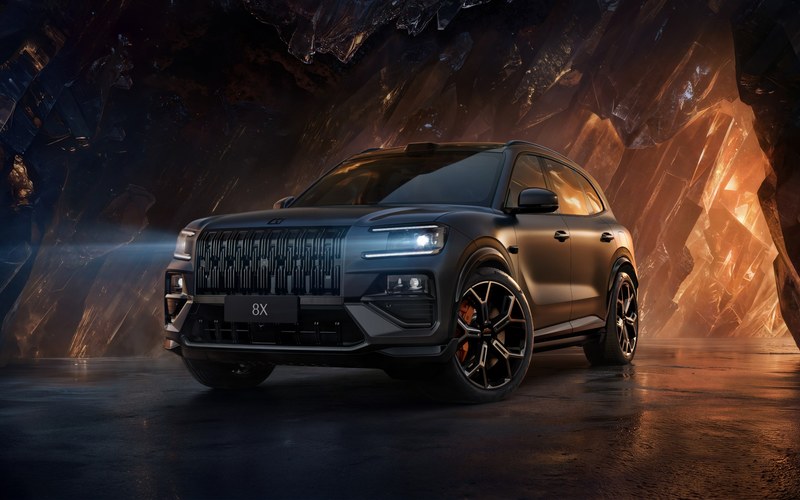
The Zeekr 8X is the newest large SUV from Zeekr, part of the Geely group. It went on sale in China on 17 April 2026 and slots in below the flagship 9X: it is shorter, but uses the same SEA-S architecture, the same 900 V system and a very similar plug-in powertrain. For buyers in Poland it suits people who want the technology of the 9X in a body that is easier to live with every day. Below we describe the versions, performance and import cost.
The 8X in the Zeekr line-up
The 8X is 5100 mm long, 1998 mm wide and 1780 mm high, with a wheelbase of 3069 mm. In China it is offered with 5- or 6-seat layouts. It is the first Zeekr with the new generation of the G-ASD (Geely Afari Smart Driving) driver-assistance system, based on NVIDIA Drive Thor-U processors and lidar.
Powertrain: 900 V, 55 and 70 kWh batteries, up to 1,030 kW
The powertrain is based on a 2.0T petrol engine rated at 205 kW, working with a 55 or 70 kWh battery and a 900 V high-voltage system. Versions with two electric motors have a system output of 660 kW (897 hp), 935 Nm and all-wheel drive; they accelerate to 100 km/h in 3.7 s. The top Black Edition version has three electric motors, 1030 kW (approx. 1400 hp) and, according to the manufacturer, reaches 100 km/h in 2.96 s.
Zeekr claims up to 410 km of electric range in the Chinese CLTC cycle and up to 1416 km of combined range with a full tank and a charged battery. These are maximum figures for the whole line-up: the range of a given version depends on the battery and the number of motors, and the CLTC cycle gives noticeably higher figures than the European WLTP. In winter and at motorway speeds the real range will be lower.
Max, Ultra, Ultra+ and Black Edition versions
In China the 8X comes in four trim levels. The Max, Ultra and Ultra+ share the same twin-motor powertrain and can have a 55 or 70 kWh battery. The Black Edition is the three-motor version and comes only with the 70 kWh battery.
| Version | Battery | Electric motors | System output | 0–100 km/h |
|---|---|---|---|---|
| Max | 55 or 70 kWh | 2 | 660 kW | 3.7 s |
| Ultra | 55 or 70 kWh | 2 | 660 kW | 3.7 s |
| Ultra+ | 55 or 70 kWh | 2 | 660 kW | 3.7 s |
| Black Edition | 70 kWh | 3 | 1030 kW | 2.96 s |
The differences between the Max, Ultra and Ultra+ mainly concern equipment: comfort, lighting, infotainment and chassis components. The Black Edition gets the most comprehensive driver-assistance package, with two Thor-U processors and five lidars. You can see the equipment of each version in the configurator.
8X or 9X
Both models share the architecture, the combustion engine and the output of the twin-motor versions. They differ in size, interior layout and performance:
- Size: the 8X is 139 mm shorter than the 9X (5100 vs 5239 mm), and its wheelbase is shorter by 100 mm (3069 vs 3169 mm). It is still a large SUV, but easier in town and when parking.
- Seats: the 9X is above all a 6-seat car with three rows (2+2+2). The 8X comes in 5- and 6-seat versions, so always check the number of seats of a specific car in its listing.
- Performance: with the same 660 kW output, the 8X accelerates to 100 km/h in 3.7 s and the 9X in 3.9–4.2 s. In the three-motor versions it is 2.96 s for the 8X and 3.1 s for the 9X.
If the third row is to be used every day, the 9X is the more sensible choice – we describe it in our Zeekr 9X guide. If the car will mainly carry four or five people, the 8X offers very similar technology in a smaller body.
GB/T charging and range
Cars from the Chinese market have a charging inlet to the Chinese GB/T standard, and the 8X we import has this inlet too. Public chargers in Poland use CCS and Type 2 connectors, so without an additional solution you cannot plug the car into a typical station. Ask an advisor about adapters and charging at home or at work.
The manufacturer quotes 6C charging: from 20 to 80% in about 9 minutes. This is achievable on very high-power Chinese chargers; you should not assume it in Poland. Because the 8X is a plug-in hybrid, the lack of a fast charger does not limit its usefulness: once the battery is depleted, it drives as a hybrid with its 2.0T engine. We write more about powertrains and charging standards in the guide EREV, plug-in or electric.
Import cost
The import cost covers the price of the car, delivery to the Netherlands, customs clearance with the agency, export licence and translations, customs duty, 23% import VAT and delivery to Poland. The 8X is a plug-in hybrid with an engine of up to 2000 cm³, so there is no excise duty in the calculation, and we calculate customs duty at 10% of the customs value, i.e. the price of the car including transport to the EU. Import VAT is charged on the customs value plus duty. The final duty rate for a specific car is confirmed by the customs agency before purchase.
An advisor will calculate the import cost for the specification you choose, and we explain the method in detail in the article The cost of importing a car from China.
FAQ
How does the Zeekr 8X differ from the 9X?
The 8X is 139 mm shorter, comes in 5- and 6-seat versions. It has the same 2.0T engine, the same 900 V system and the same output in the twin-motor versions.
Which 8X version should I choose?
The Max, Ultra and Ultra+ have identical powertrains and performance and differ in equipment. The 70 kWh battery gives a longer electric range than the 55 kWh one. The Black Edition is the choice for those who want the highest performance and the richest equipment.
Can I charge a Chinese Zeekr 8X in Poland?
Not directly at a public CCS station, because a Chinese-market car has a GB/T inlet. Ask an advisor about the available solutions. Without charging, the 8X runs as a hybrid on petrol.
What warranty does a Chinese-market Zeekr 8X have?
Do not assume a European manufacturer’s warranty. Ask an advisor about the terms, servicing and parts availability before you order.
We will import the Zeekr 8X to order in the specification you choose. Configure the Zeekr 8X or talk to an advisor – they will help you choose the version and equipment and calculate the import cost.