


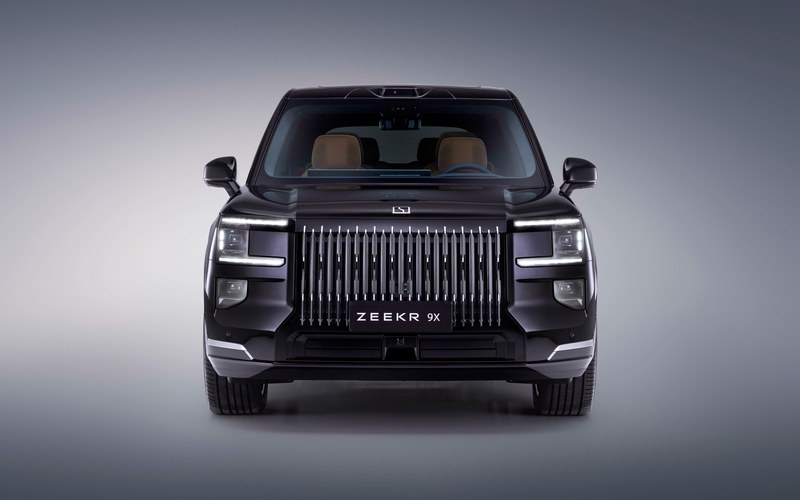
The Zeekr 9X is the largest SUV from Zeekr, a brand owned by China’s Geely group. It went on sale in China on 29 September 2025, and in less than two months customers took delivery of more than 10,000 cars. In Poland it appeals above all to people who are considering cars in the class of the Mercedes GLS or BMW X7 but want a plug-in powertrain and genuinely advanced technology. This guide sets out the versions, the performance and the practical realities of owning a 9X bought from the Chinese market.
What the Zeekr 9X is
The 9X is built on Geely’s SEA-S architecture. It combines a 2.0T petrol engine rated at 205 kW with two or three electric motors and a 900 V high-voltage system. It is a plug-in hybrid: over shorter distances it can run on electricity alone, while on longer journeys it uses the combustion engine and does not depend on chargers.
- Dimensions: 5239 mm long with a 3169 mm wheelbase.
- Interior: 6 seats in a 2+2+2 layout, i.e. two seats in each of the three rows.
- Boot: 470 l, rising to 2148 l with the seats folded (manufacturer data for the Chinese market).
- Chassis: air suspension with dual-chamber air springs and adaptive dampers as standard.
Since the end of July 2026 Zeekr has also been selling a 5-seat version in China. In the configurator you choose a 6- or 5-seat version.
Versions: Max, Ultra and Hyper
In China the 9X comes in several versions that differ in battery (55 or 70 kWh), the number of electric motors and equipment. Here the version name is more than an options pack: it determines performance and electric range.
| Version | Battery | Electric motors | System output | 0–100 km/h | Electric range (CLTC) |
|---|---|---|---|---|---|
| Max | 55 kWh | 2 | 660 kW (897 hp) | 3.9 s | 300 km |
| Ultra | 55 kWh | 2 | 660 kW (897 hp) | 3.9 s | 288 km |
| Ultra | 70 kWh | 2 | 660 kW (897 hp) | 4.2 s | 380 km |
| Hyper | 70 kWh | 3 | 1030 kW (approx. 1400 hp) | 3.1 s | 355 km |
All versions have all-wheel drive. The Max and Ultra deliver 935 Nm, the Hyper 1410 Nm. Equipment differs too: the Max rides on 20-inch wheels, the Ultra on 21-inch wheels and the Hyper on 22-inch forged wheels, with active anti-roll bars and six-piston front brake calipers. The Hyper also gets the most comprehensive driver-assistance package, with five lidars and two NVIDIA Thor processors. The black Obsidian Black edition is technically close to it.
In practice the Ultra with the 70 kWh battery has the longest electric range in the line-up, the Hyper is the fastest, and the Max is the simplest way into a 9X with the same output as the Ultra. If the 9X feels too large, see our guide to the smaller Zeekr 8X. You can also compare its versions in the Zeekr 8X configurator.
Performance and range: CLTC and WLTP
Chinese manufacturers usually quote range in the CLTC cycle, which gives noticeably higher figures than the European WLTP. For the 9X Ultra 70 kWh the manufacturer states an electric range of 380 km in the CLTC cycle. According to preliminary WLTP data, the European 9X Ultra AWD with a 55.1 kWh battery has an electric range of 179 km (ADAC catalogue). These figures cannot be compared directly, but they show how much they depend on the test method.
Once the battery is depleted, the 9X drives like a conventional hybrid. The Chinese manufacturer data for the Ultra 70 kWh give 7.1 l/100 km in this mode, while preliminary WLTP data for the European 55.1 kWh version give 8.9 l/100 km. For your own calculations it is safer to use the higher figure and to expect consumption to rise further in winter and at motorway speeds.
Acceleration does not depend on the test cycle: the Ultra 70 kWh reaches 100 km/h in 4.2 s, the Hyper in 3.1 s, and top speed is 240 km/h.
Chinese versus European version
Despite the shared name, the European 9X is a different car from the Chinese one:
- Battery: in the ADAC catalogue the European 9X Ultra AWD has a 55.1 kWh battery; the Chinese line-up also includes 70 kWh versions.
- Charging: the European version has CCS and Type 2 inlets, the Chinese one a GB/T inlet.
- Software: the interface language, maps, apps and online services in a Chinese-market car are designed for China. Ask an advisor how this works in a specific car before you buy.
- Warranty: do not assume that a Chinese-market car will be covered by the manufacturer’s European warranty. Ask an advisor about the terms before you order.
We cover these differences in more detail in the article Chinese or European version.
GB/T charging and driving on petrol
A Chinese-market Zeekr 9X has a charging inlet to the Chinese GB/T standard. Public chargers in Poland use CCS and Type 2 connectors, so without an additional solution you cannot plug the car into a typical station. Ask an advisor about adapters and charging at home or at work; the options depend on the specific car and the installation.
The manufacturer’s 6C charging claim, from 20 to 80% in about 9 minutes, applies to very high-power Chinese chargers. You should not count on it in Poland. That is why the fairest way to judge the 9X is as a large hybrid that remains fully usable even without charging, with electricity from a socket treated as a bonus if you can arrange it. We cover this in more depth in the guide EREV, plug-in or electric.
Import cost and a comparison with the Mercedes-AMG GLS 63
The import cost covers the price of the car, delivery to the Netherlands, customs clearance with the agency, the export licence and translations, customs duty, excise duty (if applicable), delivery to Poland and import VAT of 23%. The 9X is a plug-in hybrid with an engine of up to 2000 cm³, so there is no excise duty in the calculation, and we calculate customs duty at 10% of the customs value, i.e. the price of the car including transport to the EU. The final duty rate for a specific car is confirmed by the customs agency before purchase. An advisor will calculate the import cost for the specification you choose.
For comparison: the Zeekr 9X Ultra 70 kWh and the Mercedes-AMG GLS 63 4MATIC+ accelerate to 100 km/h in the same 4.2 s. Equipment, warranty, service network, charging and resale value are different, though. You will find a detailed comparison of the data in the article Chinese premium vs Mercedes, BMW and Porsche. We compare the six-seat SUV from the same group, the Lynk & Co 900, with the 9X in our Lynk & Co 900 guide.
FAQ
Can I charge a Chinese Zeekr 9X at a Polish charging station?
Not directly. A Chinese-market car has a GB/T inlet, while Polish stations use CCS and Type 2 connectors. Ask an advisor about the available solutions. Regardless of charging, the 9X runs as a hybrid on petrol.
Which 9X version should I choose?
If driving on electricity matters to you, the Ultra with the 70 kWh battery offers the most. The Hyper has the best performance and the richest equipment. The Max offers the same output as the Ultra with simpler equipment.
Does a Chinese-market Zeekr 9X come with a warranty?
Do not assume a manufacturer’s warranty valid in the EU. Ask an advisor about the terms before you order.
How is a 9X imported from China registered?
After customs clearance the car undergoes a roadworthiness inspection, the documents are translated by a sworn translator, excise duty is settled (the 9X is exempt from it), and the car is then registered at the vehicle registration office. An advisor will help you through these steps, and we describe the details in the article Registering a car from China in Poland.
We will import the Zeekr 9X to order in the specification you choose. Configure the Zeekr 9X or talk to an advisor – they will help you choose the version and equipment and calculate the import cost.