


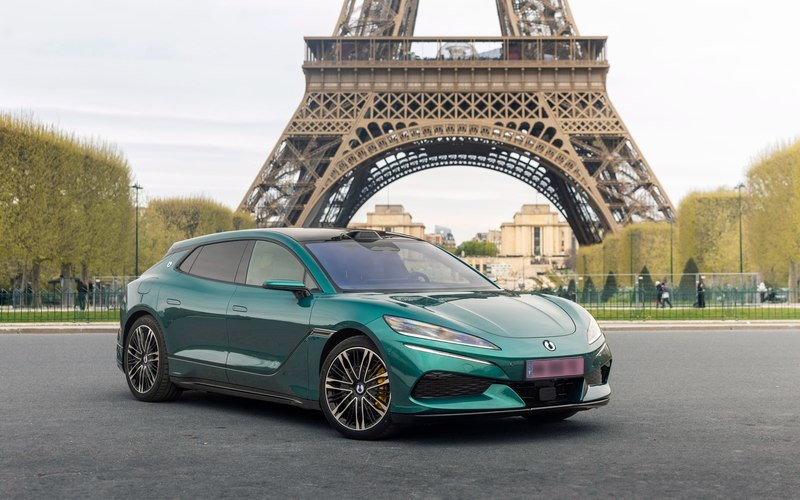
Denza is a brand that competes in China with German premium saloons and SUVs, while drawing its technology from the BYD group. Two of its models stand out: the N9, a large six-seat plug-in SUV, and the Z9GT, a five-door shooting brake. In this guide we explain how they differ, why the model year matters so much with them and what to check before buying.
Denza – BYD’s premium brand
Denza was created as a joint venture between BYD and Daimler. The German partner’s share shrank over time, and in September 2024 BYD took over 100% of the shares. Today it is BYD’s premium brand: its models use the group’s technology – Blade batteries, DM hybrid drivetrains and electric platforms – but have their own styling, equipment and tuning. The Z9GT was designed by a team led by Wolfgang Egger, previously associated with Audi.
In 2026 Denza began official sales in Europe: the Z9GT and the D9 van were presented in Paris, and orders opened in seven countries, including France, Germany, Italy and Spain. The cars we import, however, come from the Chinese market. We explain how such cars differ from European ones in the article Chinese or European version: what you gain and what you lose.
N9: a three-motor plug-in SUV
The N9 is Denza’s largest SUV: it is 5258 mm long and 2030 mm wide, with a wheelbase of 3125 mm. It seats six in a 2+2+2 layout, with two individual seats in the second row. The drivetrain combines a turbocharged 2.0 l petrol engine (152 kW) with three electric motors – one at the front and two at the rear, one for each wheel. The electric motors deliver 680 kW in total.
In the 2025 model year, the Blade battery has a capacity of 46.9 kWh. In the Chinese CLTC cycle it is enough for 202 km of electric driving, and the combined range with petrol is 1302 km. The two independent rear-axle motors allow the rear wheels to steer – the minimum turning radius is 4.65 m – and let the car move diagonally in the so-called crab mode. The equipment list also includes the God’s Eye B driver assistance package with lidar.
Z9GT: a shooting brake in two forms
The Z9GT is a low, five-seat shooting brake, 5195 mm long as a plug-in and 5180 mm long as an electric car. Sales in China began in September 2024. The Z9GT comes in two different generations of technology:
- Z9GT DM, the plug-in (2024 model year) – a turbocharged 2.0 l engine (152 kW) and three electric motors with a combined output of 640 kW, 0–100 km/h in 3.6 s, a 38.5 kWh battery, up to 201 km on electricity and about 1100 km of combined range according to CLTC. Watch the version: the Pro lacks the air suspension fitted to the Max and Ultra versions.
- Z9GT plug-in with Flash Charging (2026 model year) – according to Denza’s Chinese configurator, a turbocharged 2.0 l engine (152 kW) and three e³ electric motors (200 kW at the front and 2 × 220 kW at the rear), a 63.8 kWh battery, up to 401 km on electricity according to CLTC and 0–100 km/h in 3.6 s. Our configurator shows this version alongside the electric ones.
- Z9GT electric with Flash Charging (2026 model year) – launched in China on 5 March 2026, with second-generation Blade batteries and a range of up to 1036 km according to CLTC, depending on the version. The most powerful three-motor versions deliver 850 kW (1156 hp) and 1210 Nm and reach 100 km/h in 2.7–2.8 s. The range also includes versions with fewer motors, which is why we check the output of a specific car by its version and VIN.
The model year matters: 2024–2025 versus 2026
With Denza, the same model name can mean a completely different car. In 2026 BYD introduced the second generation of Blade batteries and Flash Charging technology: according to the manufacturer, at a suitable station the Z9GT charges from 10% to 70% in about 5 minutes and to 97% in about 9 minutes. In May 2026 the N9 received similar technology – according to Denza’s Chinese configurator, the Flash Charge version shown in our configurator has a 75.3 kWh battery instead of 46.9 kWh, 420 km of electric and 1520 km of combined range in the CLTC cycle, and reaches 100 km/h in 3.7 s.
For a buyer this means two things. First, compare cars by model year and version, not by name alone – a 2024 Z9GT and a 2026 Z9GT are cars with a different drivetrain and different technology. Second, do not pay for a feature you will not use in Poland. Flash Charging requires special BYD stations with output measured in megawatts and a suitable connector, while a car from the Chinese market has a GB/T inlet. So do not assume you will charge it at that pace in Poland.
N8L and D9: Denza’s other models
Besides the N9 and Z9GT, Denza has two other large models in its range. The N8L is a six-seat plug-in SUV with a 2.0 l engine and a length of 5200 mm – slightly shorter than the N9. The Denza D9 is a large van, 5250 mm long, with seven seats, available as a plug-in hybrid with a 1.5 l engine or as an electric car. We compare the D9 with the Voyah Dreamer in our article on luxury MPVs from China. If you are choosing between the N9 and other three-row SUVs from China, read our comparison premium 6–7-seat SUVs from China.
GB/T charging
The Denza cars we import come from the Chinese market and have the Chinese GB/T charging inlet. European charging stations and wallboxes use Type 2 and CCS2 connectors. Ask the advisor before buying how to charge the car at home and on the road – with an adapter or in another way. The answer depends on the specific car, and we do not promise solutions we have not checked for it.
In the plug-in hybrids (N9, N8L, Z9GT DM and D9 DM-i), the lack of fast charging does not immobilise the car, because the petrol engine is always there. In the electric Z9GT and the D9 EV the charging method is crucial, so settle it before ordering. We describe the details in the article EREV, plug-in or electric – and how to charge it in Poland.
Import cost
In our calculation, plug-in hybrids with an engine of up to 2.0 l are priced with 10% duty and no excise, and electric cars with 17% duty. This is our pricing method, not an official rate. The final duty for a specific car – including whether a nearly new electric car will be subject to the EU countervailing duty on electric cars from China – is confirmed by the customs agency before purchase. We write more about this in the article The cost of importing a car from China: how we calculate duty, excise and VAT.
FAQ
Is Denza a Mercedes brand?
No. Denza started as a joint venture between BYD and Daimler, but since September 2024 it has been wholly owned by BYD. The current models, including the N9 and Z9GT, are BYD designs.
Does the N9 have seven seats?
No, the N9 has six seats in a 2+2+2 layout. If you need seven seats, the D9 van offers them in the Denza range.
Which Z9GT should I choose: the 2024 plug-in or the 2026 electric car?
The 2024 plug-in is independent of fast chargers, but it has older technology and, in the Pro version, suspension without air springs. The 2026 electric car is newer, but in Poland Flash Charging will not be its advantage, and the duty for such a car has to be confirmed before purchase. For 2026 Denza also offers a Flash Charge Z9GT plug-in with a 63.8 kWh battery – you can compare both versions in the Denza Z9 GT configurator.
Does a Denza from China have a manufacturer warranty in Poland?
Do not assume a factory warranty for a car from the Chinese market, even if the brand already sells cars in Europe. Ask your advisor about the terms before you order.
How do I know which version a specific car has?
What counts is the model year, the version, the battery capacity and the equipment list, not the model name alone. When we import to order, we settle these before the purchase in China, and the advisor confirms them together with the VIN.
We will import the N9, Z9GT and D9 to order in the specification you choose: configure the Denza N9, Denza Z9 GT or Denza D9, or write to us – an advisor will help you choose the version and the way to charge it.