


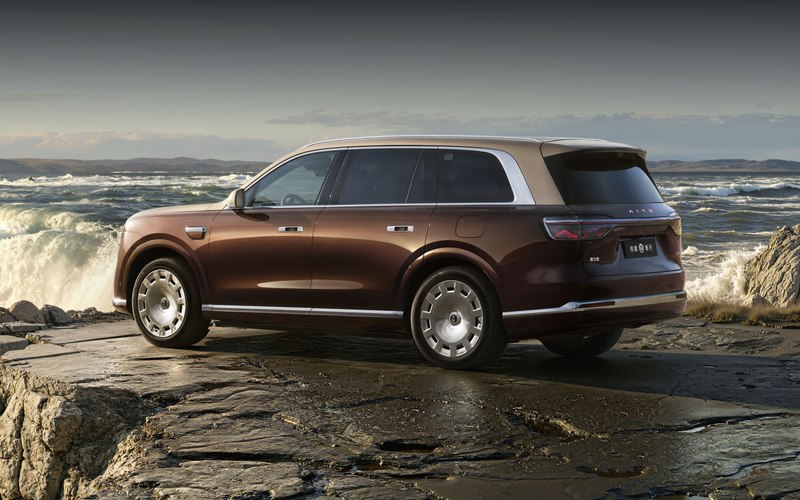
In China, the large SUV with three rows of seats is one of the most crowded premium classes. For a Polish buyer this means a choice from outside the European showrooms: large cars with a richly equipped second row and a hybrid drivetrain that lets you drive on electricity day to day. In this comparison we set side by side four models: Zeekr 9X, Li Auto L9, AITO M9 and Denza N9.
On paper they look similar: each is between 5218 and 5258 mm long, has six seats and drives both axles. Yet they differ in what matters most to a buyer: how the drivetrain works, output and the generation of technology.
Seating layout: 2+2+2 or seven seats
All four models come in six-seat versions with a 2+2+2 layout: two individual seats in the second row and two seats in the third. This layout is more comfortable for adults in the second row, and access to the third row is usually easier. The trade-off is one seat fewer than in a 2+3+2 layout, where the second row is a bench.
If you really need seven seats, the large vans have them: the electric Li Auto MEGA (102.7 kWh battery, 5350 mm long), the Denza D9 and the Voyah Dreamer. We compare the two vans in Denza D9 or Voyah Dreamer. The plug-in SUVs Lynk & Co 900 and Voyah Taishan also have six seats. Each has its own guide: Lynk & Co 900 and Voyah Taishan. The AITO M8, the M9’s smaller sibling, comes in five- and six-seat versions.
If you carry children in child seats, check on the specific car which seats have ISOFIX anchorages and whether the second-row seats slide far enough to give comfortable access to the third row. These details differ between versions and model years.
Drivetrain: plug-in (9X, N9) versus range extender (L9, M9)
All four cars combine a petrol engine with electric motors, but they do it in different ways.
- Plug-in hybrid (PHEV) – Zeekr 9X and Denza N9. In a plug-in hybrid the combustion engine can, depending on the mode, also drive the wheels. Both models have a turbocharged 2.0 l engine and very powerful electric systems: the N9 has three electric motors and a total of 680 kW, the 9X up to 1030 kW in the most powerful versions. The Zeekr 9X uses a 900 V architecture, and its 55 or 70 kWh battery allows up to 380 km on electricity according to CLTC.
- Range extender (EREV) – Li Auto L9 and AITO M9. Electric motors drive the wheels, while a turbocharged petrol engine works as a generator. In the L9 these are two electric motors, front and rear, and a 1.5 l engine. According to AITO’s Chinese configurator, the five-seat M9 versions have a 1.5 l range extender, two electric motors with a combined 497 kW and a 60 or 75.4 kWh battery, while the six-seat Ultimate versions have a 2.0 l range extender, three motors with a combined 664 kW and a 75.4 kWh battery; the M9 also comes as a fully electric car with a 120 kWh battery. The L9 from the 2024–2025 model years has a 52.3 kWh battery and about 280 km of electric range according to CLTC; cars from 2022 have a smaller battery and about 215 km. All M9 versions are described in our AITO M9 guide.
In everyday use the difference is smaller than the names suggest. All four cars can be charged from the grid and all of them keep going once the battery is depleted. In an EREV the wheels are always driven by electricity, so the driving character stays close to an electric car even with an empty battery; in a PHEV the combustion engine can join in. Remember that CLTC is a Chinese test cycle that is usually more optimistic than the European WLTP. All these cars come from the Chinese market, and the ones we import have the Chinese GB/T charging inlet – details in the article EREV, plug-in or electric – and how to charge it in Poland.
Dimensions and boot
| Model | Length | Width | Wheelbase | Seats |
|---|---|---|---|---|
| Zeekr 9X | 5239 mm | 2029 mm | 3169 mm | 6 (2+2+2) |
| Li Auto L9 | 5218 mm | 1998 mm | 3105 mm | 6 (2+2+2) |
| AITO M9 | 5402 mm | 2026 mm | 3236 mm | 6 (2+2+2) |
| Denza N9 | 5258 mm | 2030 mm | 3125 mm | 6 (2+2+2) |
The differences in length are within 40 mm, so size will not decide the choice – what is inside will. All four cars are about 2 m wide without mirrors, so measure your garage door and parking space before buying.
Manufacturers quote boot capacity using different methods, and with the third row in use, the space behind the seatbacks in each of these cars is clearly smaller than in a five-seat SUV. If you regularly travel as six with luggage for several days, measure the boot of the specific car or ask the advisor for photos with a tape measure.
Import cost: duty and excise
All four models have combustion engines of up to 2.0 l, so we calculate them with 10% duty and no excise. The final rates for a specific car are confirmed by the customs agency before purchase.
We will import any of these models to order in the specification you choose: configure the Zeekr 9X, AITO M9 or Denza N9, or ask an advisor about the Li Auto L9. We explain how we calculate the cost of import in the article The cost of importing a car from China: how we calculate duty, excise and VAT.
Which model suits whom
- Zeekr 9X – for those who want the latest technology and the highest performance in this group: a 900 V architecture, a battery of up to 70 kWh and up to 1030 kW in the most powerful versions. We describe the Max, Ultra and Hyper versions in our Zeekr 9X buyer’s guide.
- Li Auto L9 – for those who want to drive on electricity day to day and rely on the generator on longer trips. Watch the model year: cars from 2022 have a smaller battery and older systems than the 2025 versions. The second-generation L9 debuted in 2026. More in the article Li Auto MEGA and L9.
- AITO M9 – for those who value Huawei technology: the HarmonyOS infotainment system and the Qiankun ADS driver assistance package. These cars run software prepared for the Chinese market, so check the interface language, maps and apps on the specific car.
- Denza N9 – for those looking for high performance and agility: 680 kW, 0–100 km/h in 3.7 s and rear-wheel steering, which gives a turning radius of 4.65 m despite a length of 5258 mm. More about this model in our Denza N9 guide.
What to check before ordering
- the version and model year by VIN – names such as Max, Pro or Ultra mean different things for each manufacturer and in each model year,
- the battery capacity, e.g. 60, 75.4 or 120 kWh in the M9,
- the second- and third-row equipment: adjustment, ventilation, screens and ISOFIX anchorages,
- the interface language, navigation and apps – more in the article Chinese or European version,
- how to charge with a GB/T inlet – agree this with the advisor before ordering.
FAQ
Which of these SUVs has seven seats?
None – all four have at most six seats in a 2+2+2 layout. Seven seats are offered by large vans such as the Li Auto MEGA, the Denza D9 and the Voyah Dreamer.
Is an EREV better than a plug-in hybrid?
There is no single answer. An EREV, like the L9 and M9, always runs on its electric motors, and petrol is used to generate electricity. A plug-in hybrid, like the 9X and N9, can also use the combustion engine for propulsion. Your routes and your access to charging should decide.
Do these cars pay excise?
No: all four have combustion engines of up to 2.0 l, and we price plug-in hybrids and range-extender cars of that capacity without excise. The final rates for a specific car are confirmed by the customs agency before purchase.
Do they come with a manufacturer warranty in Poland?
With cars from the Chinese market, do not assume a factory warranty valid in the European Union. Ask your advisor about the terms before you order.
Would you like to compare the 9X, L9, M9 and N9 in the specification you want? Configure your car or write to us via the contact form – an advisor will help you compare versions and equipment.