


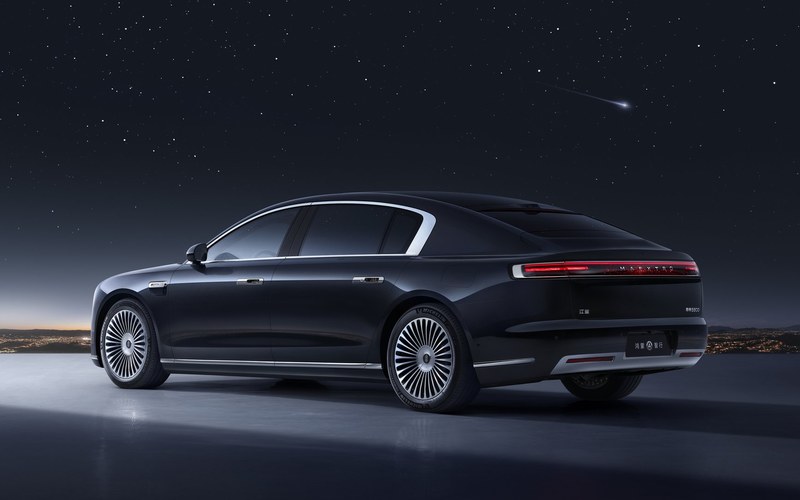
The Zeekr 9X, NIO ET9, Maextro S800 and Xiaomi SU7 Ultra increasingly appear on shortlists for a company car. “Leasing or cash”, however, is only the second question. The first is: how much of the price will count as a tax-deductible company cost at all. From 2026 the answer depends above all on the drive type and CO2 emissions, and with China-market cars the latter needs particular attention.
This guide sets out the rules in force in 2026 and shows how they apply to specific models. It is not tax advice – before signing a contract, confirm the treatment for your own company with your accountant or tax advisor.
Cost limits from 2026: three thresholds by drive type and CO2 emissions
From 1 January 2026 the value of a passenger car can be recognised as a cost only up to a limit that depends on the drive type and CO2 emissions. The amounts of the limits are set by the Polish personal and corporate income tax acts; there are three thresholds:
- the highest limit – electric and hydrogen-powered cars,
- the middle limit – cars with a combustion engine, including hybrids, with CO2 emissions below 50 g/km,
- the lowest limit – cars with CO2 emissions of 50 g/km or more.
When you buy for cash, on credit or under a finance lease, the limit applies to depreciation: write-offs on the part of the car’s value above the limit are not a cost. Under an operating lease the restriction covers the initial payment and the capital part of the instalments – the deductible share equals the ratio of the limit to the car’s value. The interest part of the instalment is not limited. Example: if the car’s value is twice the limit, half of the capital part is deductible.
According to the Polish Ministry of Finance and tax rulings issued in 2026, the new limits apply to operating lease instalments even if the contract was signed before 2026. The previous rules are kept only for cars entered in the fixed asset register by the end of 2025.
CO2 emissions: why a car from China often falls under the lowest limit
The highest limit applies to an electric car as defined in the Polish Electromobility Act, i.e. a car powered solely by electricity from a battery charged from an external source. Fully electric models such as the NIO ET9, Xiaomi SU7 Ultra, Xiaomi YU7, Li Auto MEGA or the electric versions of the Avatr 11 meet this condition. The electric models you can configure with us are described in our article on Chinese premium electric cars.
Plug-in hybrids (e.g. the Zeekr 9X) and range-extender cars, or EREVs (e.g. the Maextro S800, Li Auto L9, AITO M9), have a combustion engine, so their limit depends on CO2 emissions. The rules require this value to be taken from the central vehicle register. China-market cars go through Chinese type approval, and their documents may not include a CO2 value measured under the European WLTP procedure. If the register shows no value below 50 g/km, it is safer to assume the lowest limit and confirm this with a tax advisor before signing.
For reference: according to preliminary WLTP data, the European Zeekr 9X Ultra AWD emits 77 g/km (ADAC). Many European plug-in hybrids come in below 50 g/km under WLTP, but the European 9X does not. For a China-market car, however, what counts is the value recorded in the central vehicle register – and it is often missing.
VAT: 50% or 100%
The Polish VAT Act (art. 86a) assumes that a passenger car is used both for business and for private purposes. In that case you deduct 50% of the VAT on the purchase of the car or on the lease instalments, and also on running costs such as fuel, servicing and repairs.
Full deduction is available only if the car is used exclusively for business. You have to document this:
- register the vehicle with the tax office on form VAT-26 – no later than the 25th day of the month following the month in which the first expense was incurred,
- keep a vehicle mileage log,
- have car-use rules that exclude private use.
The tax office looks at how the car is actually used, not at the declaration alone. With a prestige SUV or an executive saloon driven by the company owner, exclusively business use can be hard to prove, so the decision on 100% is best made together with your accountant.
Operating lease, finance lease or loan – the Zeekr 9X and NIO ET9 as examples
Operating lease. The lessor owns the car and depreciates it. You pay instalments with VAT added to each of them, and when the contract ends you can buy the car out for the amount it specifies. The contract must run for at least two years.
Finance lease. The car goes into your fixed asset register and you depreciate it – within the limit. VAT on the full contract value is settled up front, when the car is handed over.
Loan or cash. You own the car from the start and depreciate it within the limit. It is the simplest structure, but the full amount weighs on the company budget at once – or, with a loan, on its borrowing capacity.
The electric NIO ET9 falls under the highest cost limit. The hybrid Zeekr 9X falls under the middle limit when its CO2 emissions are below 50 g/km, and under the lowest one when they are 50 g/km or more. With the Maextro S800 flagship saloon only a small part of its value will be deductible, so the choice of financing is more a question of liquidity than of tax. With NIO, also check in the documents that the battery is part of the car – in China NIO also offers BaaS, a model in which the battery is rented.
Whether a lessor will finance a specific imported car depends on its rules, including the car’s age, documents and valuation. We will help you arrange the lease – your advisor will give you the details.
Instalment versus total cost: insurance, servicing, depreciation
To compare financing options you need the full picture of costs, not just the instalment:
- the starting price – always the amount including transport, customs duty, excise duty and fees; we explain how we calculate it in the guide The cost of importing a car from China,
- down payment, total instalments and buyout – added up together, not separately,
- comprehensive (AC) insurance – get a broker’s quote for a China-market car before you decide,
- servicing and parts – what looking after the car involves is covered in the article Warranty, servicing, parts and depreciation,
- value at buyout and resale – the used market for premium Chinese cars in Poland is still taking shape, so be cautious about the residual value.
Keep the buyout in mind too: if after an operating lease you move the car into your private assets and sell it within six years, counted from the first day of the month following the buyout, the proceeds are taxed as business income.
What to prepare for the application
Requirements vary between banks and lessors, but they usually include:
- company details and financial documents, e.g. the latest tax return or financial statements,
- an identity document of the person representing the company,
- details of the car: make, model, version, year, mileage and VIN,
- a full calculation of the import cost,
- your decision on how VAT will be deducted and your accountant’s view on the cost limit.
The more precisely the car is described, the easier it is for the financing party to decide. That is why, with imported cars, we first agree on the car’s specification and the full cost of import, and only then on the lease terms.
FAQ
Which cost limit will apply to a Zeekr 9X bought by a company?
The Zeekr 9X is a plug-in hybrid, so what counts is the CO2 value recorded in the central vehicle register. If there is no value below 50 g/km, assume the lowest limit. Confirm the treatment for your company with a tax advisor.
Does every electric car from China qualify for the highest cost limit?
The limit covers cars powered solely by electricity. A range-extender car such as the Li Auto L9 or Maextro S800 has a combustion engine and is not an electric car within the meaning of the law.
Can I deduct 100% VAT on a premium car?
Only if the car is used exclusively for business, you register it on form VAT-26 and you keep a mileage log. Otherwise you deduct 50% VAT.
Does Azja Motors provide leasing itself?
We arrange financing with partners – banks and leasing companies. An advisor helps you choose the form of financing and prepare the documents, and presents the details individually.
If you are considering a premium car from China for your company, configure your car, then talk to an advisor about leasing. We will establish the full cost of import, which makes it easier to choose between leasing and a cash purchase together with your accountant.