


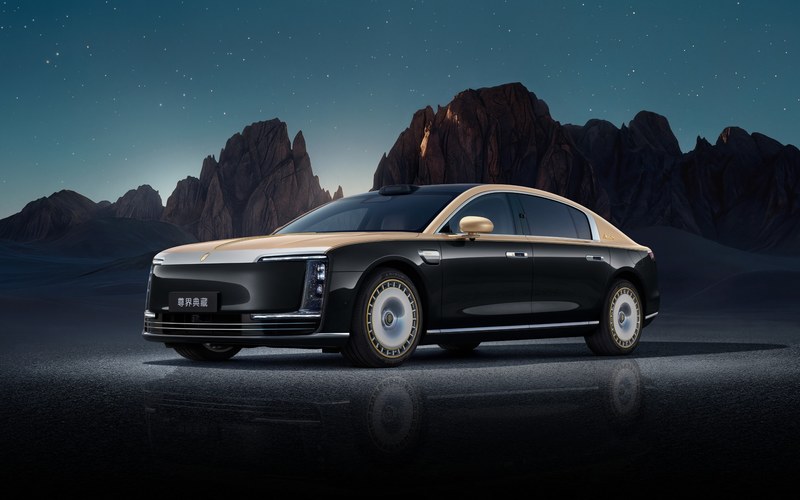
In China, the Maextro S800 was compared from day one not with other Chinese saloons but with the Mercedes-Maybach S-Class. It measures 5480 mm, has a 3370 mm wheelbase and offers either a bench or two individual seats in the rear. On top of that comes the full suite of Huawei technology. The car is engineered and built by the JAC group and sold through the HIMA alliance, in which Huawei works with several manufacturers.
In this guide we set out the facts: which S800 versions exist, how the range-extender drive differs from the fully electric version, what Huawei technology brings and what to look out for when buying a car from the Chinese market. At the end we explain what makes up the cost of importing it to Poland.
What Maextro is: Huawei, JAC and the HIMA alliance
Maextro is a brand created by Huawei and JAC Group for the very top of the market. The S800 is its first model and also the first car developed jointly by the two companies. It is built at the Maextro plant in Hefei and, in Chinese showrooms, sits alongside the other brands of the HIMA alliance (Harmony Intelligent Mobility Alliance), such as AITO, Luxeed and Stelato. Within this family it is the flagship.
The division of roles is clear. JAC is responsible for the body, production and build quality, while Huawei supplies the electronics: the driver-assistance system, the digital cockpit and connectivity. Pre-sales opened on 26 November 2024 and the market launch took place on 30 May 2025.
S800 versions: range extender or electric, 4 or 5 seats
The S800 comes with two types of drive. The first is EREV, an electric car with a range extender: the wheels are driven only by electric motors, while a 1.5T petrol engine rated at 115 kW works as a generator. The battery has a capacity of 65 kWh and the electrical system uses an 800 V architecture. The second is a fully electric BEV with a larger battery.
- EREV with two motors: 390 kW, 0–100 km/h in 4.9 s and an electric range of up to 400 km on the CLTC cycle.
- EREV with three motors: 635 kW and an electric range of up to 365 km on the CLTC cycle.
- BEV: a range of approx. 650–700 km on the CLTC cycle, depending on the version.
The second choice concerns the cabin layout. Five-seat versions have a conventional rear bench, while four-seat versions get two separate seats with a multifunction armrest between them, designed for chauffeur-driven use. You choose the drivetrain and the cabin layout in the configurator.
Interior and Huawei technology
The rear of the cabin is what matters most here. In the four-seat version, rear passengers get individual seats, and the wheelbase provides the space you expect from a car driven by a chauffeur. The S800 was designed first and foremost for the passenger rather than the driver.
On the technical side, the S800 uses the Huawei ADS 4 driver-assistance system with LiDAR sensors, a cockpit from the Harmony family and air suspension with adaptive dampers and rear-wheel steering. In China these features give the model its edge, but in Europe they call for realistic expectations: the software, maps, online services and some of the assistance functions were developed for the Chinese market.
That is why, before buying, it is worth establishing which language the interface of a given car runs in, which apps and functions will be available after registration in Poland, and what should not be assumed. We cover this in more detail in the article Chinese or European version.
The S800 and the Mercedes-Maybach S-Class
The comparison with the Maybach is natural, because both cars target the same customer: someone who sits in the back more often than they drive. The differences, however, start with the philosophy. The Mercedes-Maybach S 580 4MATIC combines a petrol drive supported by a mild-hybrid system with a service network that has been present in Poland for years. The Maextro S800 relies on electric drive with a generator, extensive software and Huawei technology.
Beyond the technical data, what surrounds the car matters too: warranty, servicing, depreciation and equipment differ between the two. You will find a detailed comparison of the data in the article Chinese premium vs Mercedes, BMW and Porsche.
Charging and range in Poland
In Polish conditions the EREV drive is the least demanding. In everyday use the S800 can run on electricity, and on longer journeys the combustion generator tops up the energy without any need to look for a fast charger. Bear in mind, however, that the range on the CLTC cycle is noticeably higher than what the European WLTP procedure or winter motorway driving will show, so use more conservative figures for planning.
Cars from the Chinese market generally have a charging inlet to the GB/T standard rather than the European CCS2. The cars we import, the Maextro S800 included, have the Chinese GB/T inlet. The fast charging that the 800 V architecture enables in China therefore does not automatically carry over to Polish chargers. Discuss with an adviser which solution makes sense for a specific car – at home, at work and on the road. You can read more about charging standards in the article EREV, plug-in or electric.
Import cost and what it is made of
The import cost covers the price of the car, transport to the EU, customs clearance and fees, our services and taxes. This is how we calculate the taxes:
- Customs duty – calculated on the customs value, i.e. the price of the car plus transport to the EU. In our calculation we assume 10%, and 17% for fully electric cars. The final rate for a specific car – including in the context of EU countervailing duties on new electric cars from China and whether the car counts as new or used – is confirmed by the customs agency before purchase.
- Excise duty – the S800 EREV has a 1.5 l engine, so in our calculation the excise duty is 0%. Electric cars as well as plug-in hybrids and range-extender cars with an engine of up to 2.0 l are exempt.
- Import VAT – 23% of the sum of the customs value, duty and excise.
An advisor will calculate the full import cost for the specification you choose, and we describe the rules in the article the cost of importing a car from China. We also offer leasing and insurance – an advisor will give you the details.
FAQ
Is Maextro a Huawei brand?
Not quite. Maextro is a joint brand of Huawei and JAC Group: JAC builds the car, Huawei supplies the technology, and sales are handled within the HIMA alliance. With us you can configure the Maextro S800 and import it to order.
EREV or BEV – which S800 version should you choose?
For driving in Poland and across Europe, the EREV is the more sensible choice: it offers electric driving every day and independence from chargers on the road. The BEV makes sense if most of your journeys are short and you charge the car at home or at work.
Does a China-market S800 have a warranty in Poland?
Do not assume a manufacturer’s factory warranty in the EU for a car from the Chinese market. Ask about the terms, servicing and parts availability before you order; we write more about this in the article warranty, servicing and parts.
Can such a car be registered in Poland?
Yes. The process includes customs clearance, settling the excise duty, a technical inspection, translations of documents and registration at the vehicle registration office, among other steps, and an adviser helps you through each of them. You will find a description of the procedure in the article registering a car from China in Poland.
How long does it take to import an S800?
An adviser will give you the timing, as it depends on the specification you choose. It is worth asking about it in the first conversation, together with your questions about the version and equipment.
If you are also considering other flagship saloons, see the guide NIO ET9 and flagship saloons from China. We will import the Maextro S800 to order in the specification you choose: configure the Maextro S800 or discuss the versions, costs and formalities in a conversation with an adviser.